

It’s still early with he conversion but I have to say that I am impressed with the upgrade. The upgrade has impacted things both expected and unexpected.
Lead Acid Batteries
Originally we had installed Lead Acid batteries mainly due to lack of knowledge and cost. With the electric conversion batteries are a critical component. As I didn’t understand enough about batteries, here is what I knew; that the original 12 volt house and engine batteries couldn’t keep the lights on overnight. I had incandescent bulbs and was pulling about 4.2 amps with my anchor, engine and interior cabin lightning on. The batteries were 12 volts, and 100Ah deep cell. The batteries were well used, and I had to start the engine in the morning in order to get the batteries recharged. They were way below 50% consumed by the morning so they were not holding a charge well.
To remedy I changed all lightning to LED and replaced all old wiring with proper gauged wire. (See Blue Sea Systems for a great Wiring Chart)
As I didn’t know enough about batteries at the time I knew from playing golf that many electric golf carts could last all day even and still provided power at the end of the day. My experiences here swayed me to go with 6v trojan 225 Ah batteries. I should be able to get over 100Ah now (to remain over 50% consumed) instead of the 50Ah I had before.
I went with this ever since I put the electric in (2020). Generally speaking these lead acid batteries met the bill. I picked up 1 (yes one) solar panel, 100 watts and I started on my journey of learning all about electric power.
I could go roughly 2 hours on these lead acid batteries but charging was very slow. What I learned is that the Victron solar MPPT controller keeps the rate of charge at a level that the Lead Acid batteries can receive. It’s slow, 4.5 amps is what I saw. Even after I bulked up my solar to 400 watts, the rate of charge is still the same so I had to wait with depleted batteries at times.
As I changed and upgraded my cooking stove to an induction cooktop and started moving everything to electric (no gas, no fumes) power becomes very important and the charge rate had me plugging into shore power more often than I wanted to.
Going with LiFoPO4 Batteries
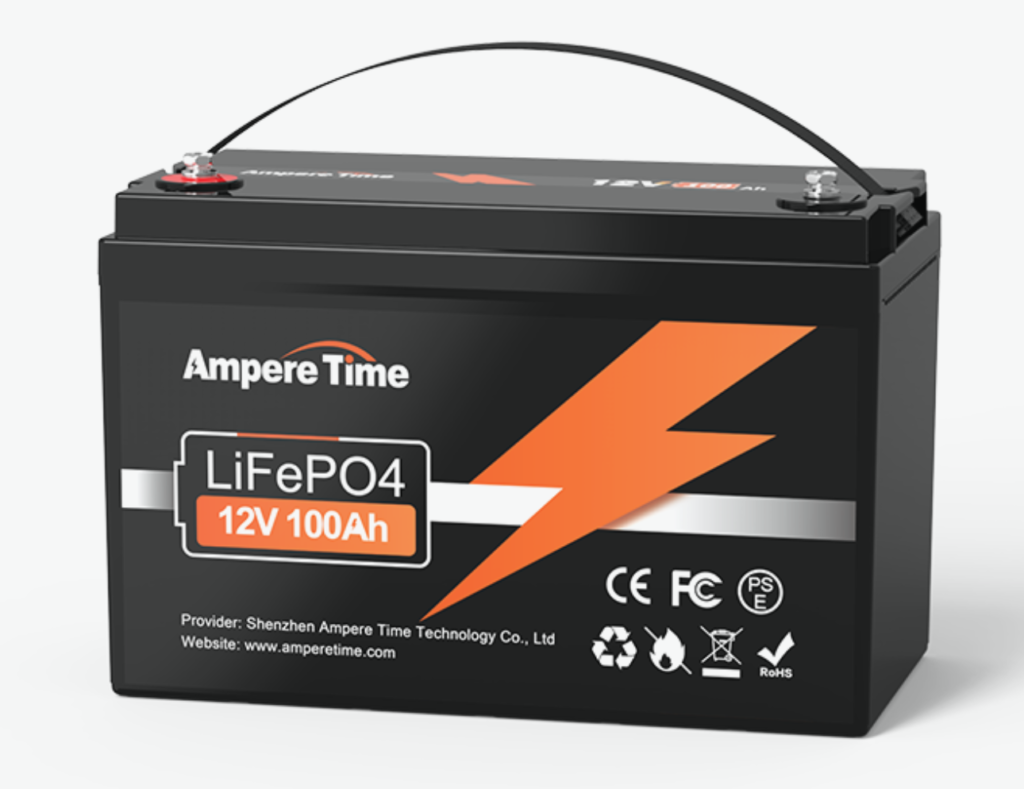
I won’t go into the decision of (why) which vendor I picked but I did choose Ampere Time, and selected 12 volt 100Ah batteries. Again, a little cautious I wanted to make certain they worked as advertised.
They were much lighter (23 lbs as opposed to 70 lbs) and all arrived at 13.4 volts, at 40%. I later learned from their documentation that regulations do not let LiFoPO4 batteries ship at full charge. I had no way to charge them aside from my MPPT controller so I went ahead and installed them.
At the same time I also upgraded my solar and charger. I added in some breakers I could reset and another 4 panels totalling 800 watts. I set the solar as a 4 panels by 2 in parallel so I doubled up my amps.
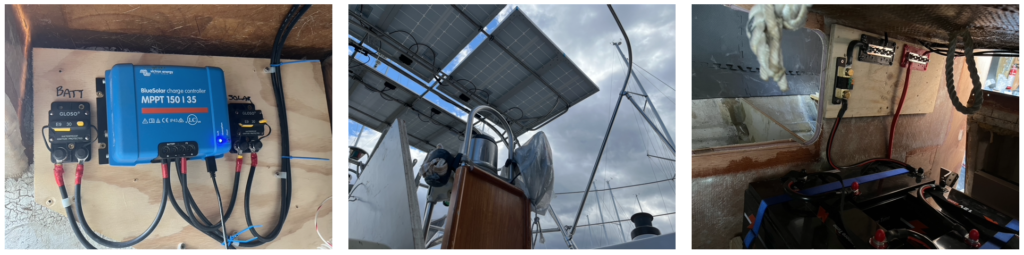
But instead of getting 9 amps I saw almost 16 amps of charge rate.
This single attribute, the faster charging rates, is something that I didn’t quite understand until I put it in.
What it meant was that literally in a few hours I had charged these batteries up. In practice where I used to wait for the batteries to be at a certain state of charge before I would venture out, I found that by the morning I was already way over 90% even after consuming power all night.
With the DC fridge, cooking, powering the water pumps, listening to music, leaving the MacBook plugged in all night and various electronic equipment and phones charging, I’d end up with an 83% state of charge in the morning and even on a cloudy overcast day I am still getting a little charging to slowly bring me back up.
I have found that the LiFoPO4 upgrade has greatly lessoned my concern for power. I am still weary and very careful of the power consumption, but nowhere at the same levels I was with Lead Acid. Going electric for the motor causes a reliance on power that I didn’t expect. And I didn’t expect that the charge rate of going to Lithium would alleviate that concern as much as it did.
One thing to note that I had 2 ’emergency’ situations where I needed to push the Lead Acid batteries. Once was at anchor at Sandbanks and a 58knot storm microburst blew us off anchor. After dragging we powered up the motor and had to push them pretty hard into the wind to get back to a safe anchoring location. The second was when a taker was coming in through the Hamilton Harbor lift bridge canal and I wanted to stay ahead of it. These 2 situations almost depleted my Lead Acid batteries as I had the boat running at 5+ knots and about 75 amps (3500 watts). If found that the lead acid batteries really needed a slow multi-day recharge from shore power to get them to behave ‘normally’. My solar would have taken a week so I had to plug into shore power to get them to charge faster.
Bottom line is that I am very pleased with the LiFoPO4 batteries and unexpectedly have a better quality of sailing lifestyle as a result of the upgrade.
Some Comparisons (not a pros vs cons)
| Lead Acid | Lithium LiFoPO4 Batteries |
| Heavy | Light |
| Power level continually gets lower as drained as used | Power level stays much flatter but drops like a cliff at 80% to 90% |
| Can’t use more than 50% advertised – 100Ah really means 50Ah | Can use up to 80% as advertised – 100Ah really means 80Ah |
| Slow Charging Times | Faster Charging Times |
| Lower Peak Discharge Rate ( I have to top out at 3 knots to conserve my batteries – 25 Amp discharge rate) | Higher Peak Discharge Rates (I can max out my motor, with 100 Amp discharge rate, 200 Amp if in parallel) |
| Wow getting these batteries in and out killed my back | Can you believe I can lift 100Ah with one arm? |
| Initial Cost Cheap $ | Initial Cost Expensive $$$ |
| Get away with smaller cables $ | Needs bigger cables $$$ |
| Less concern over temperatures while charging | Do not charge these batteries under 5′ Celsius |
If you want a better stats based comparison of lead acid vs lithium LiFoPO4 you can get this at power-source.com they have a great article on it.
*I am not sponsored in any way, this is just my blog about my experiences


Recent Comments