
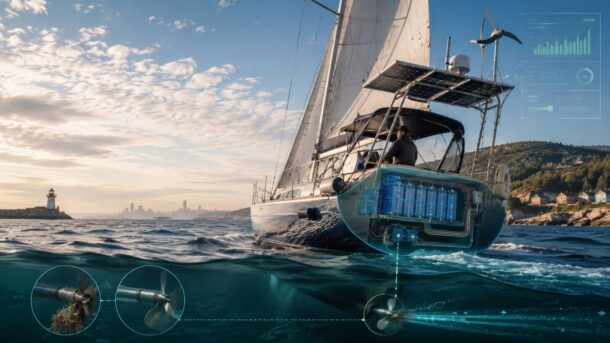
The Hamilton-to-Shelburne trip was a strong test as it combined canals, rivers, coastal motoring, offshore conditions, and a three-day passage from Cape Cod to Nova Scotia. A total of 1400+ nautical miles were recorded on the Raymarine ST60 Instrument.
What 1,000+ Miles Taught Me About Electric Propulsion on a Sailboat
This summer (2025) over a 2 month period I travelled from Hamilton, Ontario to Shelburne, Nova Scotia, taking our sailboat through the Erie Canal, down the Hudson River, through New York Harbor, and then north along the U.S. East Coast. The final major leg was an offshore crossing from Cape Cod to Shelburne, Nova Scotia, which took approximately three days.
The trip was a very good real-world test of our electric propulsion and 48V electrical system.
It also exposed three problems that weren’t obvious while testing the boat close to home: propeller fouling, inadequate DC cabling, and the limitations of using multiple independent lithium battery BMSs in a high-current 48V system.
All three became much more important once we were travelling for days at a time and relying on the system continuously.
Lesson #1: Propeller Fouling Is a Serious Problem for Electric Propulsion
I fouled the propeller three times during the trip.
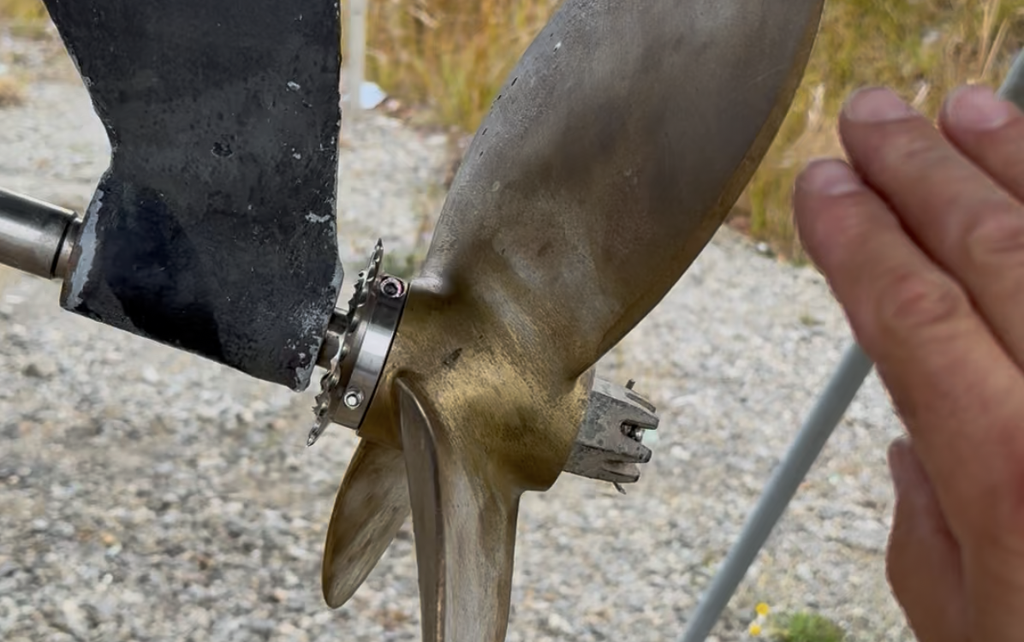
Once the fowling was rope. The other two were large balls of seaweed that looked like a root ball that wrapped themselves around the propeller and shaft.
With a diesel engine, you may notice a reduction in RPM or additional vibration. With electric propulsion, the effect was particularly noticeable because the motor immediately had to produce significantly more torque to try to maintain RPM. I had some net performance impact which impacted my energy consumption.
The motor would struggle, electrical consumption would increase, and boat speed would fall.
That is exactly the opposite of what you want when operating from batteries. On my last 2 hours from the coast into Shelburne Marina, I lost 15% of batteries even while running my generator to compensate for running the motor.
After dealing with this several times, I installed an AB Marine Shaft Shark – propeller rope cutter on the prop shaft.
For our boat, I’ve come to consider the rope cutter an important part of the electric propulsion system rather than simply an optional accessory.
Electric motors can produce considerable torque at low RPM. Preventing rope, fishing line, weeds and other material from wrapping around the shaft reduces the chance of a relatively minor obstruction turning into a propulsion or electrical problem.
Lesson #2: 2/0 Cable Isn’t Necessarily 2/0 Cable
The second lesson involved something I originally assumed was straightforward: battery cable.
Our propulsion system can place substantial continuous loads on a 48V battery bank. At those power levels, cable resistance matters.
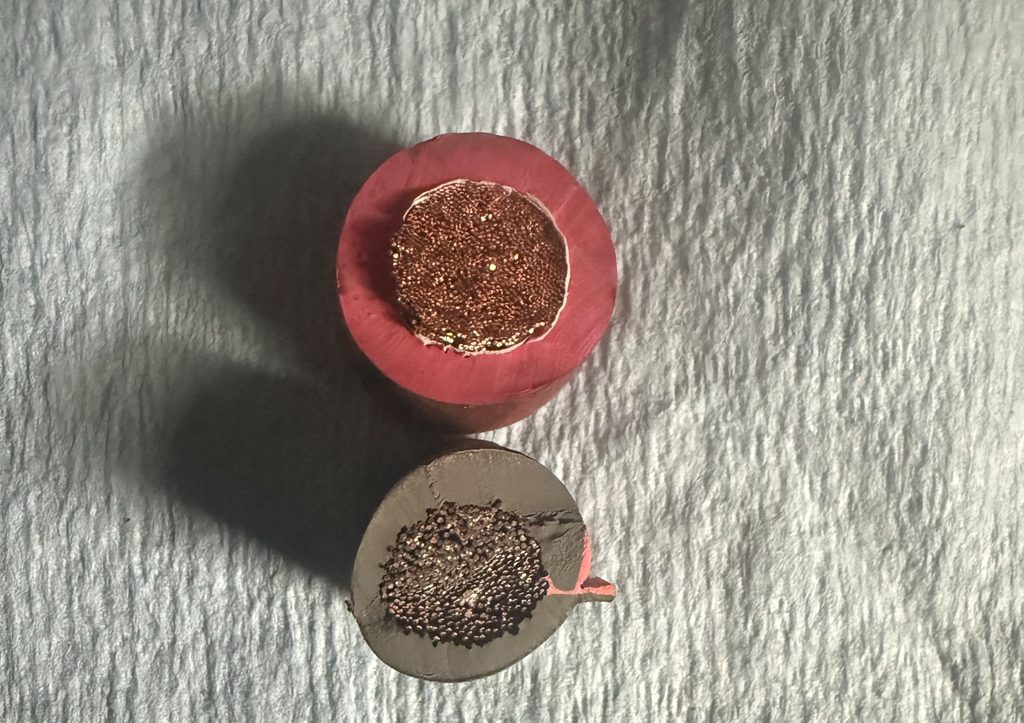
I had purchased cable advertised as 2/0 gauge, but eventually discovered that the inexpensive imported cable I had received was not equivalent to the properly sized marine cable I expected.
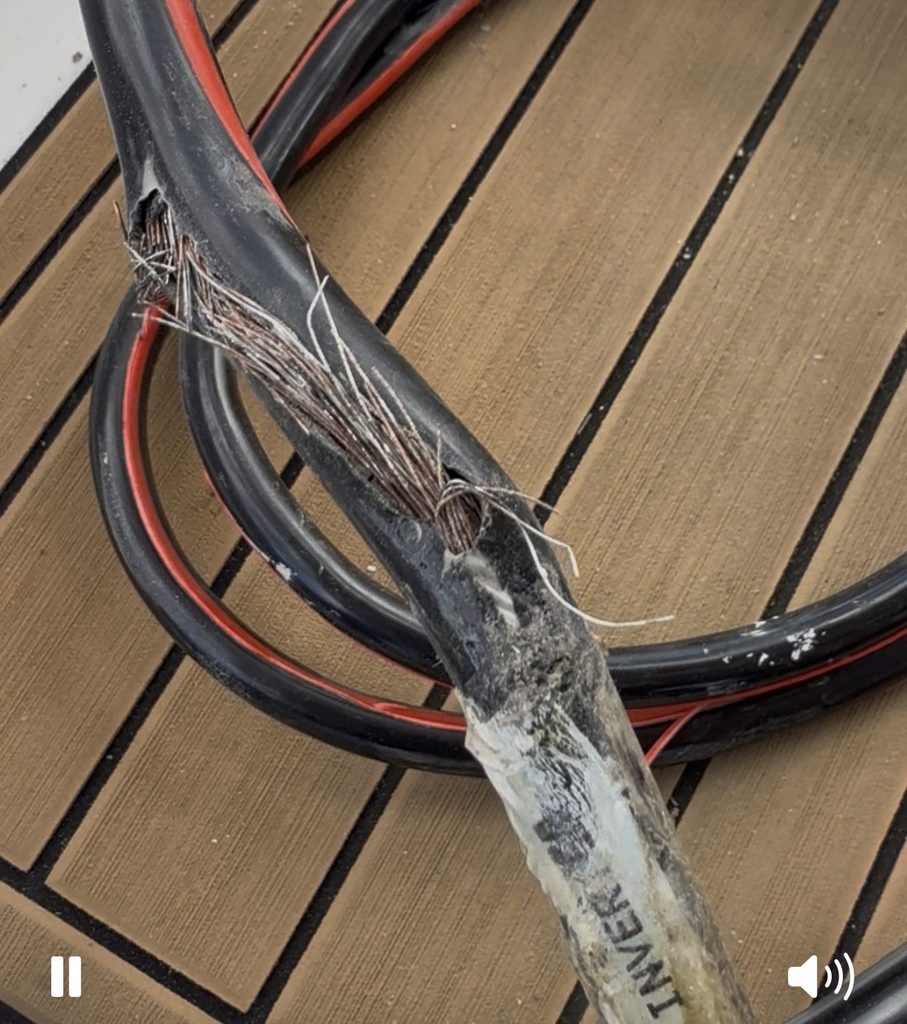
The difference matters.
How did this come about? I either had a on the dock electrical back feed issue from another boat or it was already blown from my dead cell – the BMS in the battery should have stopped any run away current and I also have properly sized breakers for both the shore power and the connections internally so I have no conclusive evidence as no breaker was tripped. I just had a poor exploded negative cable from the bus to the Victron Quattro.
Wire marked “2/0” should not automatically be assumed to have the same conductor cross-section, strand construction, insulation characteristics or current-carrying capability as properly specified marine-grade cable.
I ultimately replaced questionable cabling with proper ABYC-suitable marine battery cable.
One of my biggest takeaways from the trip is simple:
Stick with ABYC approved cable.
For battery and propulsion wiring, use cable from a reputable supplier and verify that the conductor size and construction actually meet the specification required for the installation. Measure a cross section and inspect the copper. I think my Chinese cable was actually some other metal and not copper.
Lesson #3: Four Lithium Batteries Doesn’t Necessarily Mean One Battery Bank
The most difficult problem turned out to be the lithium battery bank.
I originally had four LiTime 230Ah batteries making up the propulsion battery system.
Each battery contained its own independent BMS.
On paper this sounds reasonable. Each battery protects itself against over-voltage, under-voltage, excessive current and individual cell problems.
The difficulty is that the four BMSs don’t coordinate with one another.
During the trip, one cell failed in one battery and I eventually had to RMA one of the batteries. That left me with three batteries of one age and condition and one new replacement battery.
Afterward, I began experiencing intermittent charging problems.
Sometimes the system would charge normally. Other times one of the BMSs would decide that something was outside its acceptable operating range and disconnect its battery.
Troubleshooting this became extremely difficult because I effectively had four independent battery-management systems each making its own decisions inside what I needed to behave as a single 48V battery bank.
I spent several days tracking down what was happening.
Eventually, I decided to change the architecture completely.
Converting the Bank to a True 48V Battery
I disassembled the four batteries and removed their individual BMS units.
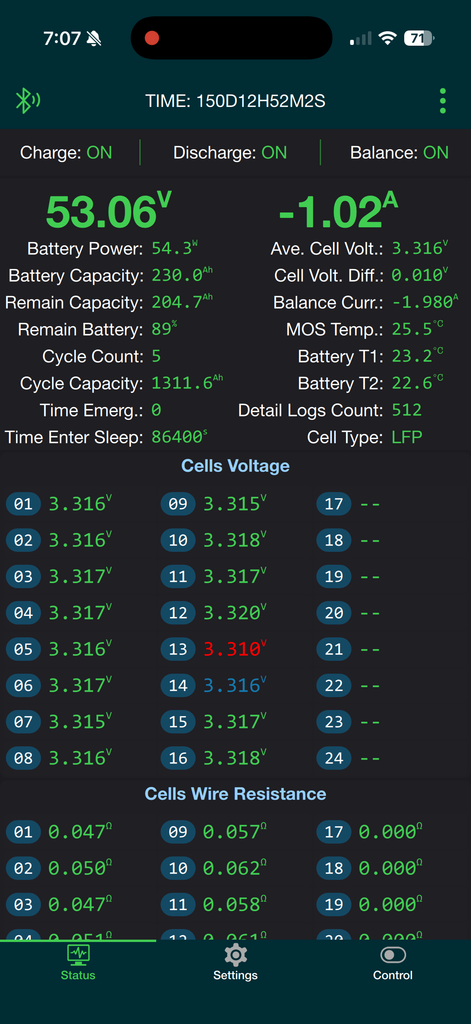
The sixteen LiFePO4 cells were then configured as a single 16-cell 48V nominal battery bank.
Instead of four independent BMSs, the entire bank is now managed by one:
JK-B2A24S30P Smart BMS — 8S-24S, 300A, with 2A active balancing, Bluetooth and RS485.
That changed the system fundamentally.
Instead of four separate controllers trying to protect four separate batteries connected together, I now have one BMS monitoring all 16 cells as one 48V battery.
It can see the voltage of every cell, actively balance the cells and make charge/discharge decisions based on the condition of the complete battery.
After rebuilding and testing the bank, the charging problems disappeared.
What the System Looks Like Now
The real test wasn’t whether the system worked for an afternoon at the dock.
It was whether it could operate continuously.
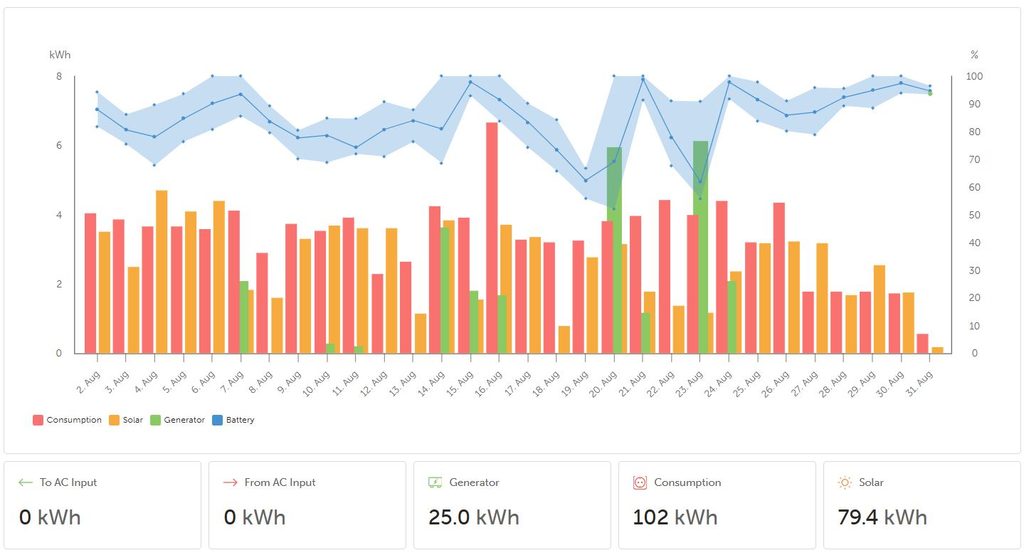
The Victron Energy data below shows approximately the last 30 days of actual operation after the battery changes.
During that period:
- Total consumption: 102 kWh
- Solar production: 79.4 kWh
- Generator production: 25.0 kWh
- The battery generally remained at a high state of charge despite continuous onboard electrical consumption.
The solar contribution is particularly important. During this 30-day period, solar generated energy equivalent to roughly 78% of the boat’s total electrical consumption. The generator provided additional energy when solar production, propulsion use or weather conditions required it.
The numbers won’t balance perfectly because energy flows, timing, battery charging and conversion losses all affect what Victron records in each category, but the overall picture is clear: the system is now operating sustainably for extended periods rather than simply working during short tests.
The Bigger Lesson
The trip changed how I look at electric propulsion. The electric motor itself was not really the difficult part. The challenges were the systems surrounding it.
A reliable electric propulsion installation depends on the entire chain:
Battery cells → BMS → cabling → connections → controller → motor → shaft → propeller
A weakness anywhere in that chain can affect the entire propulsion system.
From Hamilton to Nova Scotia, the three biggest improvements ended up being surprisingly practical:
- Protect the propeller and shaft from fouling.
- Use genuine, correctly sized marine-grade DC cable.
- Treat a large lithium bank as one integrated electrical system rather than assuming several independent BMS-equipped batteries will always cooperate.
After the changes, particularly converting the battery bank to a single 16S system with one JK BMS, the boat’s electrical system has become considerably more predictable.
And on a boat travelling offshore, predictability is far more important than impressive specifications on paper.

Recent Comments